


 English
 中文简体
中文简体
 Español
 عربى
عربى
 Français
 Português
Elastic Cotton Bandage
Cotton Cohesive Bandage
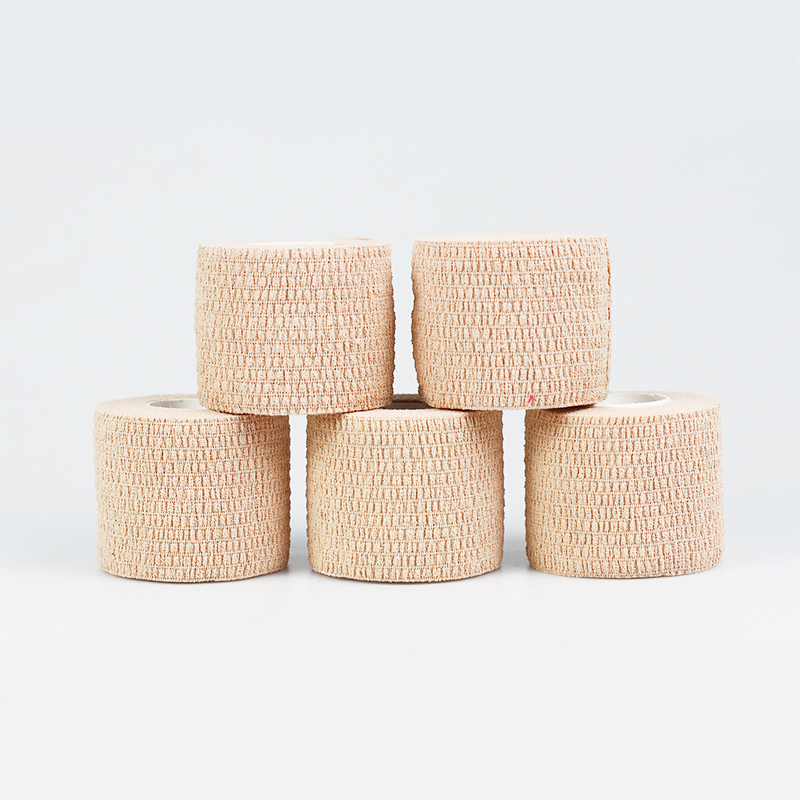
Cotton self-adhesive bandage is a type of bandage made of cotton fabric and coated with self-adhesive adhesive layer. Its main feature is that it only adheres to itself and does not stick to the skin or hair.
Main features:
1. Self-adhesive (key feature): No need for pins, clips or tape for fixation. Just wrap it and it will stick by itself, making it convenient to use.
2. Good breathability: The non-woven fabric material gives it good breathability, preventing skin from becoming sweaty and damp, reducing discomfort.
3. Moderate elasticity: Provides uniform pressure and good fit, can adapt to the contours of various body parts, such as joints, without affecting movement.
4. Soft and comfortable: The material is soft and has good skin compatibility, making it comfortable to wear.
5. Easy to tear and remove: No need for scissors, just tear it off with your hands; when removing, simply slowly loosen it, painless and without leaving any residual glue.
6. Cost-effective: High cost performance. Main uses: Fixing dressings: This is the core purpose. Used to fix gauze, cotton pads and other wound dressings to prevent them from shifting or falling off. Provide mild compression: Used to handle soft tissue injuries such as sprains and strains, providing mild compression and support to help reduce swelling. Sports protection: Provides mild support and protection for athletes' wrist joints, ankle joints, etc. Used for wrapping hands (such as boxing, fighting), fixing sports equipment, etc. Post-operative care: Used to fix dressings on post-operative wounds or for compression bandaging. Pet care: Because it does not stick to hair, it is suitable for wrapping wounds for pets.
About Us
Wenzhou Zhusi Medical Supplies Co., Ltd.
Wenzhou Zhusi Medical is a custom cotton cohesive bandage factory. We specialize in self-adhesive cotton cohesive bandage, providing professional care solutions for clients in the fields of sports, medical care, personal care, animal health, tattoos, and beauty. Through technology and innovation, we strive to enable everyone in the world to enjoy a healthy and fulfilling life.
Our Mission:
We strive to achieve both material and spiritual well-being for all employees, spread love and health, and promote the accessibility of healthcare products to everyday families.
Our Vision:
To become a renowned company recognized by customers, respected by society, and ensuring employee well-being.
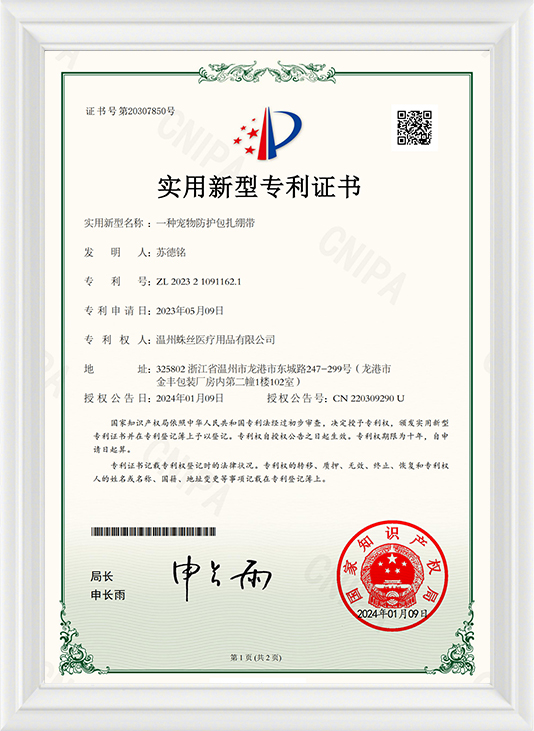
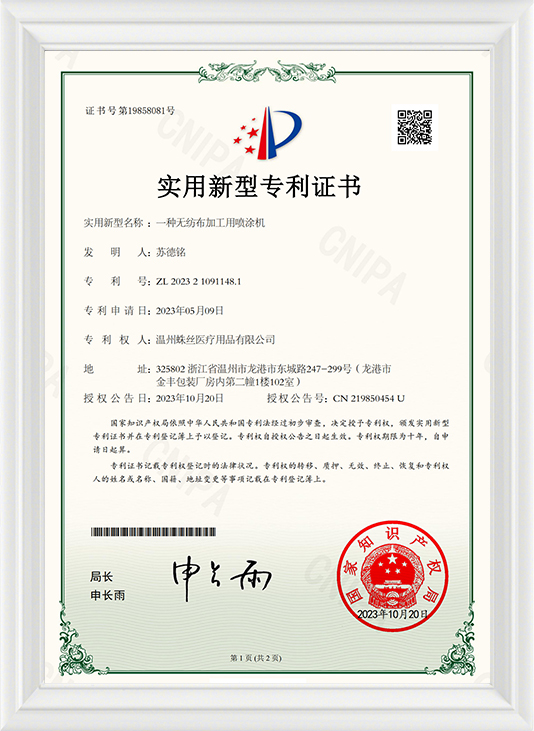
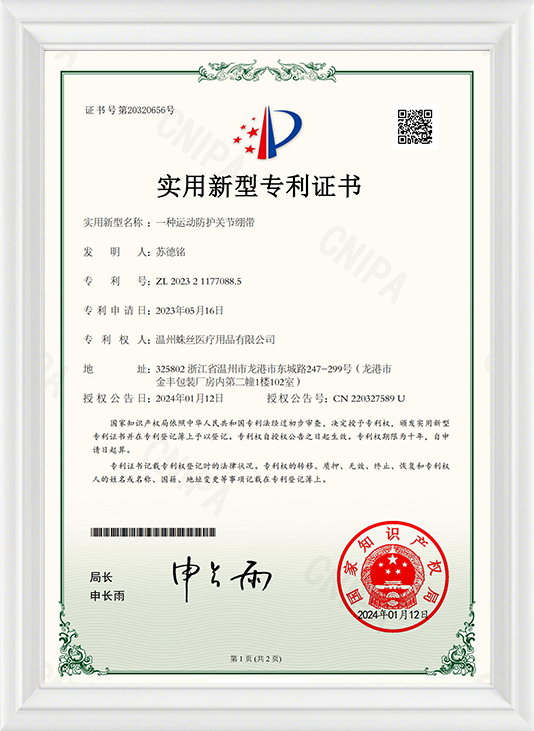
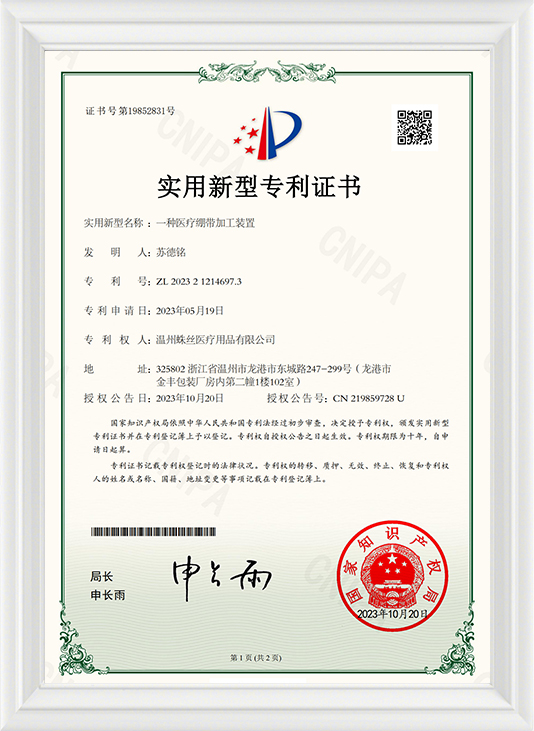
Certificate Of Honor
News
-
Sports taping is often treated as a simple wrapping task, but the material placed closest to the skin can influence how the outer tape feels...
READ MORE -
A bandage placed around a joint has to deal with constant changes in the shape of the skin. When an ankle bends, a wrist turns, or a knee fl...
READ MORE -
A cohesive bandage can look simple to use. It stretches, wraps around an area, and holds against itself without needing ordinary adhesive on...
READ MORE -
A bandage may look simple, but its performance depends on how it behaves after it has been wrapped around the body. It needs to remain in po...
READ MORE
Message Feedback
Cotton Cohesive Bandage: Soft, Flexible and Easy to Apply
A cotton cohesive bandage is a flexible wrap that holds to itself through overlapping layers. Unlike conventional adhesive products, it is not designed to bond directly to the skin or hair. Once wrapped, the cohesive surfaces connect with each other, helping the bandage stay in position without clips, pins or additional tape.
The cotton-based surface gives the wrap a soft, familiar feel, while elastic fibers allow it to follow the shape of hands, wrists, elbows, ankles and other contoured areas. This combination makes the product convenient for first-aid ranges, pharmacies, sports supplies, veterinary products, healthcare distribution and private-label programs.
Cotton cohesive bandages can be manufactured in different widths, roll lengths, colors and packaging formats. Material composition, stretch, cohesive strength and latex status should be clearly defined before sampling or mass production.
What Is a Cotton Cohesive Bandage?
A cotton cohesive bandage is made from cotton or a cotton-blend fabric, elastic yarns and a self-cohesive compound. The cohesive coating creates a layer-to-layer grip when the bandage overlaps itself. It does not function in the same way as pressure-sensitive adhesive tape.
The bandage is designed to:
- Adhere to its own overlapping layers rather than directly to skin or hair
- Offer a soft cotton-based contact surface
- Stretch around curved, narrow or moving areas
- Stay in place without separate clips or fasteners
- Support hand tearing or scissor cutting, depending on fabric density
- Fit a variety of retail, clinical, sports and veterinary applications
- Allow customization of width, length, color, printing and packaging
Not every cotton cohesive wrap has the same construction. Cotton content, maximum elongation, elastic recovery, coating formula and roll weight may vary between models. Products described as latex-free should be supported by the relevant material specification or test documentation.
Elastic Cotton Wrap
An elastic cotton wrap combines the texture of cotton with controlled extensibility. The fabric stretches during application and follows the shape of the wrapped area, helping reduce loose edges and heavy folds.
Compared with a rigid woven wrap, an elastic cotton bandage is usually easier to position around joints and uneven contours. The finished feel depends on the fabric weight, elastic yarn arrangement, stretch ratio and applied tension.
Main characteristics
- Cotton or cotton-blend fabric construction
- Added elastic fibers for flexibility
- Soft and comfortable surface texture
- Cohesive coating that grips overlapping layers
- No separate clips, pins or tape required
- Compact and lightweight roll format
- Narrow and wide roll options
- Neutral, bright and customized colors
- Individual wrapping, retail boxes or bulk cartons
- Optional private-label packaging
An elastic cotton wrap should be applied with light, consistent tension. Pulling it to its maximum extension may create unnecessary pressure and reduce comfort. Application instructions should match the product’s intended use and technical characteristics.
Materials and Construction
The performance of a cotton cohesive bandage is determined by the entire construction, not only by how soft the surface feels. Fabric weight affects thickness and hand feel, elastic fibers control stretch and recovery, and the cohesive compound determines how firmly the layers connect.
The following components are commonly considered during product development:
| Component | Purpose | Specification Check |
| Cotton or cotton-blend fabric | Creates a soft contact surface | Confirm fiber content, fabric weight and texture |
| Elastic fibers | Provide stretch and help the wrap follow contours | Check elongation range and elastic recovery |
| Cohesive compound | Enables the layers to grip each other | Confirm cohesive strength and latex status |
| Color pigment | Produces neutral, bright or custom shades | Review color consistency and colorfastness |
| Inner core | Supports the roll and assists unwinding | Confirm core material and diameter |
| Protective wrapper | Helps protect the roll during transport and storage | Select individual, retail or bulk packaging |
A complete OEM specification should identify:
- Fiber composition or required cotton percentage
- Fabric weight and finished thickness
- Latex-containing or latex-free formulation
- Maximum stretch and recovery requirements
- Finished width and roll length
- Permitted dimensional tolerances
- Cohesive strength expectations
- Hand-tear or scissor-cut requirement
- Color reference or printing artwork
- Inner core and packaging method
- Label language and market information
Clear technical details help ensure that the approved sample and mass-produced bandages have consistent softness, stretch, cohesion and roll dimensions.
Available Sizes, Colors and Packaging
Cotton cohesive bandages are available in configurations suitable for pharmacies, first-aid brands, sports suppliers, healthcare distributors, veterinary companies and promotional product ranges. Standard specifications may be available for faster production, while customized projects normally require confirmation of quantity, materials and artwork.
Common customization options
- Widths: Narrow rolls are suitable for fingers, paws and smaller areas, while wider formats cover larger surfaces with fewer turns.
- Roll lengths: Short rolls fit portable kits and retail packs. Longer rolls may be more practical for regular professional use.
- Colors: Common options include beige, white, black, blue, red, green, pink, purple and other custom shades.
- Designs: Solid-color fabrics are widely used. Printed patterns may also be produced when the material, printing method and order quantity are suitable.
- Packaging: Options include individual flow packs, transparent wrappers, printed pouches, retail boxes, display cartons and bulk export cartons.
- Branding: Private-label services may include logos, product names, barcodes, instructions, warning statements and carton markings.
- Sets: Several widths or colors can be combined in one retail package when production and packing arrangements permit.
Finished dimensions should always be defined as either stretched or unstretched measurements. Width tolerance, length tolerance, core size and rolls per carton should also appear in the approved specification.
Color appearance can vary slightly between material batches. For custom shades, a recognized color reference and pre-production sample help establish an acceptable standard.
How to Choose the Right Cotton Cohesive Wrap
The right cotton cohesive wrap depends on the application area, required stretch, packaging channel and destination-market rules. A product intended for a small retail first-aid kit may need a different width, wrapper and label from one supplied to a veterinary distributor or sports brand.
1. Select the appropriate width
Narrow cohesive bandages are easier to guide around fingers, hands, small joints and animal paws. Wider rolls cover larger areas more quickly and may require fewer overlapping turns.
The selected width should fit the intended application without creating excessive folds. It should also match the space available inside the retail box, pouch or kit.
2. Check the stretch level
A highly elastic cotton wrap can adapt closely to curved or moving areas. A lower-stretch construction may feel firmer and offer more controlled handling.
Maximum elongation alone does not provide a complete picture. Elastic recovery is also important because it shows how the material behaves after being stretched. Samples should be checked at realistic application tension rather than only at maximum extension.
3. Confirm the cohesive formulation
Some cohesive bandages use a compound containing natural rubber latex. Other products are made with a latex-free cohesive formula.
When latex status is important, the requirement should be stated in the technical specification, product label and supporting documents. A latex-free claim should not be based only on appearance or general product description.
4. Consider the end-use environment
Different sales and use environments may require different product configurations:
- Retail first-aid products may need individual wrapping and consumer instructions.
- Pharmacy products may require barcodes, expiry information and local-language labels.
- Sports wraps may use bright colors, team shades or multi-roll packs.
- Healthcare supplies may require specific documentation and traceability information.
- Veterinary wraps may need several widths for small and large animals.
- E-commerce products may need durable packaging for parcel delivery.
The intended use should be established before finalizing the fabric, roll dimensions and packaging.
5. Review packaging and labeling requirements
Before production begins, confirm:
- Product name
- Intended purpose
- Fiber composition
- Latex status
- Bandage width and roll length
- Storage conditions
- Manufacturing or expiry information, where applicable
- Lot or batch identification
- Directions for use
- Applicable cautions and warning statements
- Country of origin
- Destination-market language
- Importer or distributor information
- Barcode and retail artwork
- Carton quantity and shipping marks
Packaging artwork should be reviewed together with the technical specification. This helps prevent inconsistencies between the label claims and the physical product.
How to Apply a Cohesive Cotton Bandage
A cohesive cotton bandage should be wrapped with gentle, even tension. It does not need to be pulled to its maximum stretch to hold in place.
- Make sure the application area is clean and dry.
- Unroll a short section of the bandage without fully stretching it.
- Position the first turn gently around the selected area.
- Continue wrapping with each new layer overlapping the previous one.
- Keep the tension light and consistent throughout the application.
- Avoid wrinkles, twisted edges and excessively thick folds.
- Tear the bandage by hand or cut it with scissors, depending on the material.
- Press the final end against the previous layer so the cohesive surfaces connect.
- Check the wrapped area for comfort, circulation and freedom of movement.
- The bandage should feel secure but not excessively tight. It should be removed and reapplied if increasing pain, numbness, tingling, discoloration, coldness or unusual swelling occurs.
When a cohesive cotton wrap is used around an injury, surgical site or wound dressing, application should follow the directions supplied with the product and any instructions provided by a qualified healthcare or veterinary professional.
Cotton Cohesive Bandage vs. Standard Woven Bandage
Cotton cohesive bandages and standard woven bandages may look similar in roll form, but they fasten differently. A cohesive wrap grips itself, while a non-cohesive woven bandage generally needs tape, clips, pins or another securing method.
| Feature | Cotton Cohesive Bandage | Standard Woven Bandage |
| Fastening method | Holds through overlapping cohesive layers | Often requires tape, clips or pins |
| Direct skin adhesion | Designed to grip itself rather than skin or hair | Depends on the separate fastening method |
| Elasticity | Commonly available with controlled stretch | May be elastic or non-elastic |
| Contouring | Conforms easily around joints and curved areas | Depends on fabric structure |
| Application | Quick wrapping without separate fasteners | May require an additional securing step |
| Removal | Layers can usually be unwrapped or cut away | Fasteners must be removed separately |
| Color options | Neutral, bright, printed or customized | Often white or beige |
| Packaging | Suitable for individual, retail and bulk formats | Also available in retail and bulk formats |
A cotton cohesive bandage is often selected for convenient fastening, flexibility and easy contouring. A standard woven bandage remains appropriate when a non-cohesive material or separate securing method is preferred.
The two products are not automatically interchangeable. Selection should be based on the intended purpose, material specification and application instructions.
Frequently Asked Questions
This section answers common questions about cotton cohesive bandage materials, performance, application and customization.
Does a cotton cohesive bandage stick to the skin?
A cotton cohesive bandage is designed to adhere to its own overlapping layers rather than directly to the skin or hair. The self-cohesive surfaces create enough grip to hold the wrap together.
Temporary contact with skin may still occur during application. Individual material sensitivity and the specific cohesive formula should be considered when selecting a product.
Is an elastic cotton wrap reusable?
Most elastic cotton wraps are intended for limited use or single-user application. After removal, the material may lose cohesive strength, stretch recovery or cleanliness.
Reuse should only be considered when it is consistent with the product instructions, hygiene requirements and intended application.
Can cotton cohesive bandages be torn by hand?
Some lightweight cotton cohesive bandages can be torn by hand. Thicker or more densely woven products may require scissors for a clean edge.
Hand-tear performance depends on the fabric structure, fiber arrangement, coating and finished thickness. This feature should be tested on an actual sample rather than assumed from the product name.
Are all cotton cohesive bandages latex-free?
No. Some cotton cohesive bandages contain a cohesive compound made with natural rubber latex, while others use a latex-free formulation.
Latex status should be confirmed through the product specification, labeling and relevant supporting documentation. The presence or absence of latex cannot be determined reliably from color or texture.
What colors are available?
Frequently used colors include beige, white, black, blue, red, green, pink and purple. Other shades may be produced to match a brand identity, sports theme or retail collection.
Custom colors usually require a color reference, minimum production quantity and sample approval. Printed patterns may involve separate artwork and printing requirements.
What information is needed for a custom order?
A custom order should include the required material composition, cotton content, latex status, width, roll length, stretch, color, printing, individual wrapper, retail box, label language, destination market and estimated quantity.
Providing complete details at the beginning makes material selection and sample development more efficient.
Is a cohesive bandage the same as adhesive tape?
No. Adhesive tape is designed to stick directly to a surface. A cohesive bandage is designed to grip its own overlapping layers.
Because the cohesive material does not rely on direct adhesion to hair, removal is generally more convenient than removing conventional adhesive tape. However, the exact performance still depends on the formulation and application method.
A cotton cohesive bandage brings together a soft cotton-based surface, elastic flexibility and self-cohesive fastening. It can be wrapped around curved or moving areas without separate clips and can be customized for healthcare, first-aid, sports, veterinary, pharmacy and private-label product lines.
For OEM and wholesale production, the specification should clearly define fiber composition, cotton percentage, latex status, roll dimensions, stretch, cohesive performance, color and packaging. Detailed product requirements, approved samples and consistent quality checks help reduce variation between development samples and mass production.

“This website is for users outside of China.”
Copyright © 2025 Wenzhou Zhusi Medical Supplies Co., Ltd. All Reserved. Approval No:浙温械备20250002 & 浙温械备 20190061 号 & 浙温药监械生产备20190011号
Cotton Bandage Factory
